If you're designing circuit boards, assembling motors, or working on anything that gets really hot, you've probably held a roll of that amber-colored, almost papery tape called polyimide tape. One question keeps coming up in workshops and engineering meetings: Is this stuff electrically conductive?
Here's the straightforward answer: By itself, no. But it can be made to be.
Understanding this difference isn't just technical trivia—it's what keeps your designs safe and functional. Let's walk through what polyimide tape really does, and when you might need a special version.
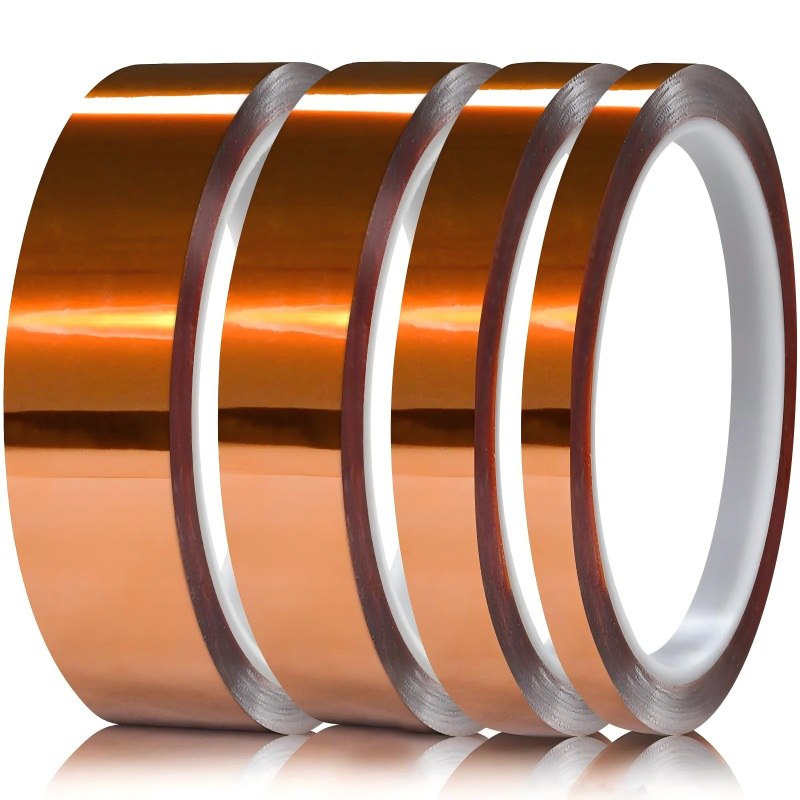
Think of standard polyimide film tape as the ultimate protector. Its main job is insulation—keeping electricity exactly where you want it. The golden-brown film you see is polyimide, a material that laughs at conditions that would destroy ordinary tapes.
A typical polyimide electrical tape (like the PI tape referenced in industry specs) gives you:
• Heat resistance that goes far beyond most materials (think 280°C continuously without leaving glue behind)
• Strong electrical insulation (withstanding 6kV or more in many grades)
• Chemical toughness against oils, solvents, and acids
• Mechanical strength that stays consistent from freezing cold to oven-hot temperatures
This is why you'll find it wrapped around motor coils, protecting flexible cables in printers, and masking circuit boards during soldering. It's the guard, not the wire.
Now, here's where it gets interesting. While the film itself blocks electricity, engineers can transform polyimide tape into something that conducts. They do this by adding special ingredients.
Two common ways this happens:
1.Adding a conductive layer: Imagine putting a microscopically thin sheet of copper or aluminum on one side of the polyimide film. You get the heat resistance of polyimide with the electrical properties of metal.
2.Mixing in conductive particles: Some manufacturers blend tiny silver, nickel, or carbon particles right into the adhesive. When the tape sticks, these particles create pathways for electricity to flow through.
• Shielding sensitive electronics from electromagnetic interference (EMI)
• Creating static-safe workspaces for assembling delicate components
• Building flexible heating elements for specialized equipment
• Providing grounding in tight spaces where wires won't fit
If you need these functions, you don't just buy "polyimide tape"—you specifically look for "conductive polyimide tape" or "EMI shielding tape."
| If your project needs | Choose this type | Because |
| Insulation in high-heat areas | Standard polyimide tape | Nothing else handles extreme temperatures while staying non-conductive |
| Temporary protection during soldering | Double sided polyimide masking tapes | They stick securely but remove cleanly after heat exposure |
| EMI/RFI shielding in tight spaces | Conductive-coated polyimide tape | Provides shielding without sacrificing thermal performance |
| General wire bundling at room temperature | Standard electrical tape | More cost-effective for basic needs |
Here's what many engineers discover the hard way: not all polyimide tape performs the same. The difference between tape that works and tape that fails often comes down to manufacturing control.
At QKD, we've been manufacturing high-performance tapes for over 15 years. Our 15,000㎡ production facility gives us something crucial: complete control from raw materials to finished rolls. When we produce polyimide tape, we're not just buying film and adding glue—we're engineering the entire system.
This vertical integration means we can ensure that every roll of QKD polyimide tape delivers consistent thickness, reliable adhesion, and stable performance across its entire temperature range. Our ISO 9001 certification and compliance with UL, IEC, CE, and RoHS standards aren't just certificates on the wall—they're built into every production batch.
For engineers working on critical applications, this consistency matters. Whether you need standard insulation tape or custom double sided polyimide masking tapes for specialized assembly processes, our OEM/ODM approach means we can develop exactly what your project requires.
The most important lesson? Never assume. Just because a tape is gold-brown doesn't mean it's standard polyimide, and just because it's called polyimide doesn't mean it's non-conductive.
Before you specify any polyimide tape:
1.Check the technical data sheet for conductivity/resistivity values
2.Verify the temperature range matches your application
3.Confirm any certifications needed for your industry
4.When in doubt, request samples for real-world testing
Q1: Can I use standard polyimide tape for EMI shielding?
No, standard polyimide tape is an electrical insulator and will not provide EMI shielding. For shielding applications, you need specifically engineered conductive polyimide tape with metalized coatings or conductive adhesive.
Q2: Is polyimide tape waterproof?
While polyimide tape offers excellent chemical and moisture resistance, it is not designed as a primary waterproof sealing solution. For true waterproofing applications, consider dedicated waterproof pipe insulation tape or butyl rubber tapes instead.
Q3: What's the difference between polyimide tape and Kapton tape?
Kapton is a well-known brand name for polyimide film developed by DuPont. In practical terms, most high-quality polyimide film tape performs similarly, though specific formulations may vary between manufacturers like QKD.
Q4: Can polyimide tape be used for outdoor electrical applications?
While polyimide tape has excellent UV and temperature resistance, outdoor electrical applications often require additional environmental protection. It can be used in conjunction with waterproof wire tape or as part of a layered insulation system.
Q5: How does QKD ensure consistent quality in polyimide tape production?
As an experienced polyimide tape manufacturer, QKD controls the entire production process from polymer synthesis to precision coating in our 15,000㎡ facility. Our ISO 9001 certified quality system ensures every batch meets strict performance standards.
Q6: Can I get custom-sized polyimide tape?
Yes, through QKD's OEM/ODM services, we can customize width, length, thickness, and even develop double sided polyimide masking tapes with specific adhesion properties for your application.
Q7: What temperature can polyimide tape withstand?
High-quality polyimide electrical tape like that produced by QKD can typically withstand continuous temperatures up to 260°C-280°C, with short-term peaks up to 400°C depending on the specific grade.
Q8: Is polyimide tape safe for food-grade applications?
Standard polyimide tape is not specifically designed or certified for direct food contact. For such applications, you would need tapes with appropriate food-grade certifications.
Q9: How long does polyimide tape last in storage?
When stored properly in cool, dry conditions away from direct sunlight, most polyimide tape maintains its properties for 12-24 months. QKD provides specific shelf life recommendations with each product.
Q10: Can polyimide tape be removed cleanly after high-temperature exposure?
Quality polyimide tape from reputable manufacturers like QKD is designed to provide clean removal even after exposure to high temperatures, though removal ease can depend on the specific surface and exposure conditions.
What is Polyimide Tape? The Ultimate Guide to the Invisible Hero of High-Tech Manufacturing
What is the Difference Between Polyimide and Polyester Tape?


